Hi, I'm Severin Gartland
I work on machine learning and web development, with a deep interest in how technology enables new forms of experience and understanding. Under here you can learn a bit more about me and see some of the projects I have worked on.
By day I am a philosophy student, having completed my first MA thesis on new forms of composability and meaning made possible by the internet.
Experience
I'm currently a Research Master's student in philosophy at KU Leuven, where I am writing on the philosophy of technology and materiality within the context of post-Kantian European philosophy. Previously I have studied philosophy, psychology and sociology at the University of Oslo and UC Berkeley.
Alongside my studies I have worked on machine learning projects aimed at discovering new ways of relating to large corpora of text. This includes making the Husserl archive at KU Leuven accessible through semantic search and computational conceptual mapping, as well as designing a novel method for large scale literature review of didactic research at a center for excellent education at the University of Oslo. I've also worked as a research assistant in clinical psychology exploring the use of digital tools for diagnosing personality disorders and validating diagnostic instruments. Previously, I have taken up work developing navigational tools and booking platforms.
During my time at the University of Oslo, I've worked as a tutor and mentor for first year philosophy students, teaching metaphysics, history of philosophy, ethics and academic writing skills.
For a complete CV, please contact me directly.
Some Recent Projects
digitalHusserl
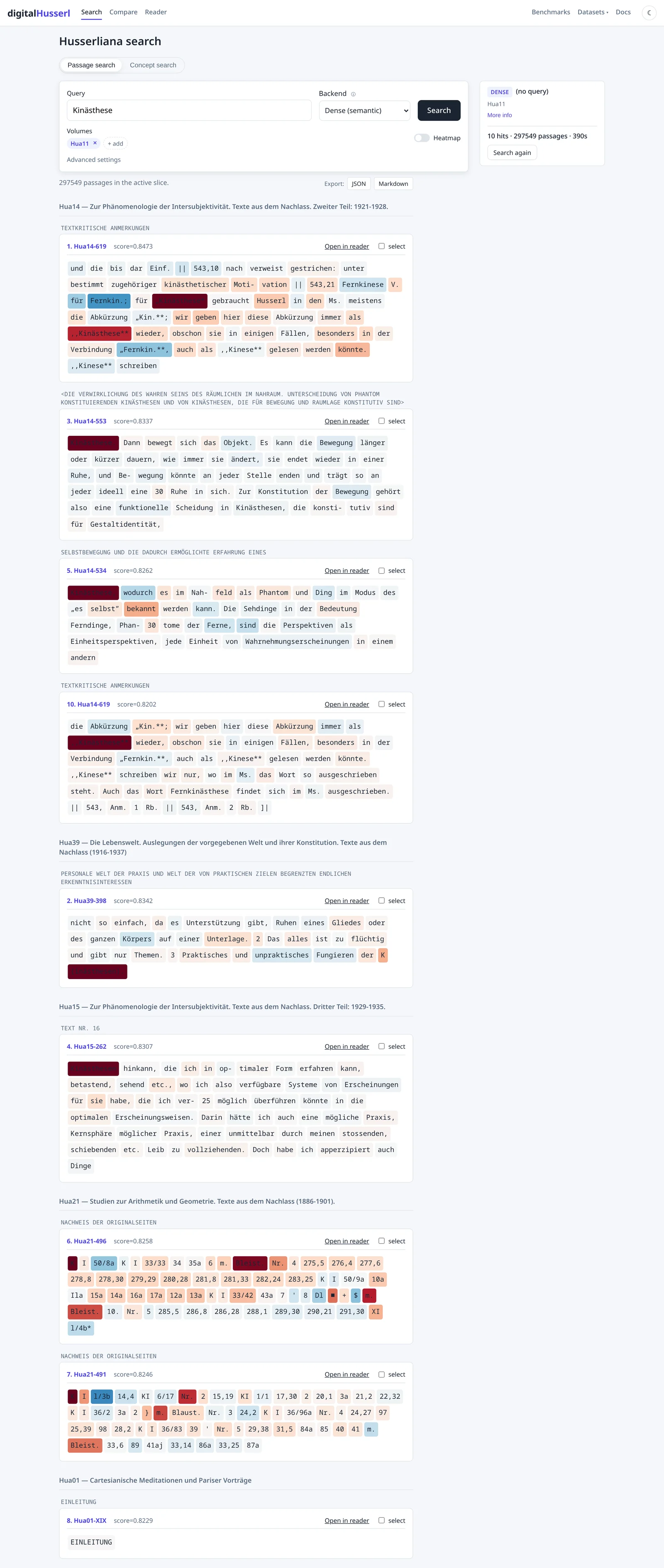
Private repository — report available on requestResearch software for the Institute of Philosophy at KU Leuven, where the Husserl Archives are held. Husserl's collected works run to 43 volumes and some 26,000 pages of dense German, and the search tool in use could only match literal words — which fails exactly where it matters, since Husserl will discuss a concept for pages without ever naming it. I built a system that searches by meaning instead: nine interchangeable retrieval backends behind a single interface, from BM25 through dense embeddings to an LLM that greps and reads the corpus with tools, served through a FastAPI and Svelte app where you can compare two methods on the same query and read a result in its original page with the words that drove the match tinted in place.
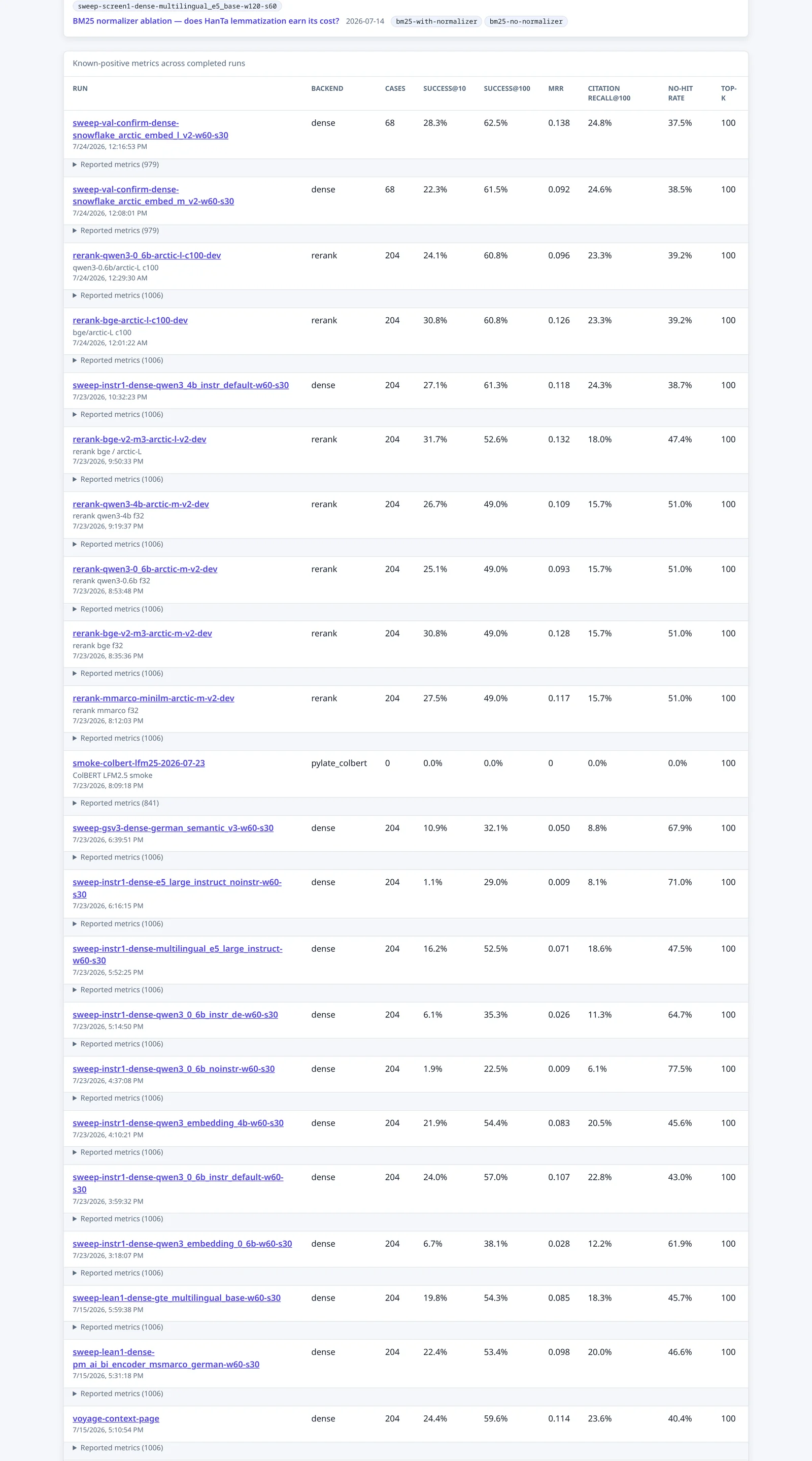
The harder half was working out whether any of it worked. There is no labelled retrieval data for Husserl, so I built a benchmark out of the citation apparatus of three published Husserl dictionaries — 4,736 citations resolved to volume and page — with a test split I have not looked at, and used it to settle chunking, lemmatisation and model choice on evidence rather than intuition. Sixteen embedding models went through it. The result I care about most is a negative one: my own hypothesis, that a concept could be represented as a centroid in embedding space and found where its name is absent, lost to simply embedding the query. The report says so. I would rather write that down than round it up.
A good deal of the work was infrastructure rather than models. Embedding a corpus this size means renting GPUs, so I built the pod lifecycle around that — create, discover over SSH, run, pull results, terminate, in one command — and versioned the resulting ~34 GB of embeddings with DVC against object storage, so that the code and the artefacts it depends on stay in step without either ending up in git. The licensed corpus and the dictionary text stay out of version control entirely; what ships alongside the code is hash-referenced metadata.
Reading a research field computationally
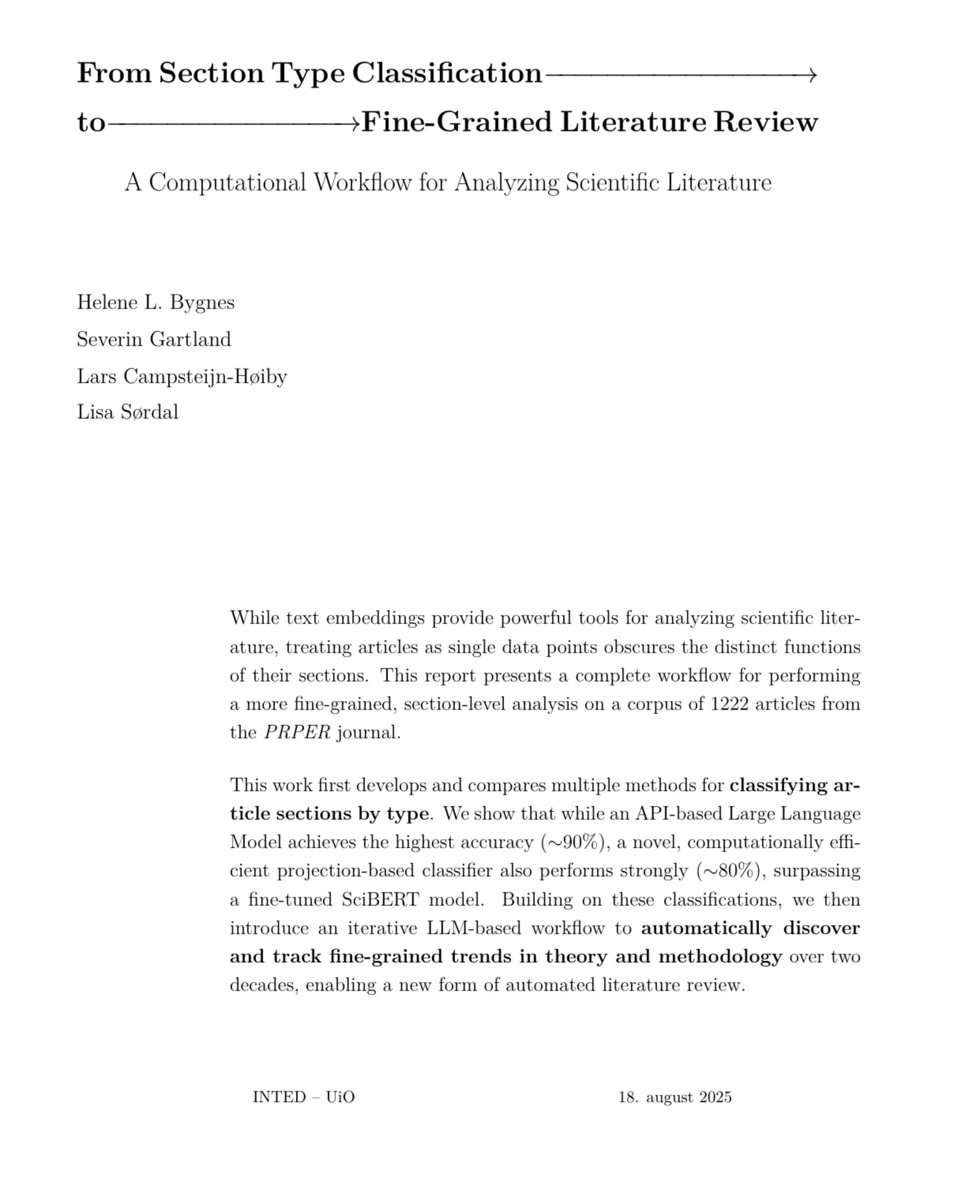
Github or read the reportOver the summer of 2025 I worked in a four-person research team at INTED, the Centre for Interdisciplinary Education at the University of Oslo, on how you read a research field computationally. The usual approach embeds each paper as a single vector, which throws away the fact that a paper has parts doing different jobs — an introduction argues, a methods section describes, a theory section situates. I built the pipeline to test the alternative: parsing 1,222 articles from Physical Review Physics Education Research out of XML into 7,313 sections, embedding each one, and validating that nothing had gone missing along the way.
The harder question was what kind of section each one was. Between us we tried five approaches — a hand-tuned heuristic, a fine-tuned SciBERT, a geometric classifier built on distances between class centroids, the same scores through a small neural net, and simply asking an LLM. My teammate Lars built the SciBERT and projection models; I built the heuristic baseline, the evaluation framework we scored all of them with, and the LLM pipeline that did the production run at around 90% accuracy against our hand-labelled benchmark. With the sections labelled, I wrote a classifier that has an LLM discover its own categories from the text, review and merge them, then re-classify — which pulled 135 distinct theoretical frameworks out of the corpus and let us chart how the field's interests shifted across twenty years.
A portfolio for a visual artist
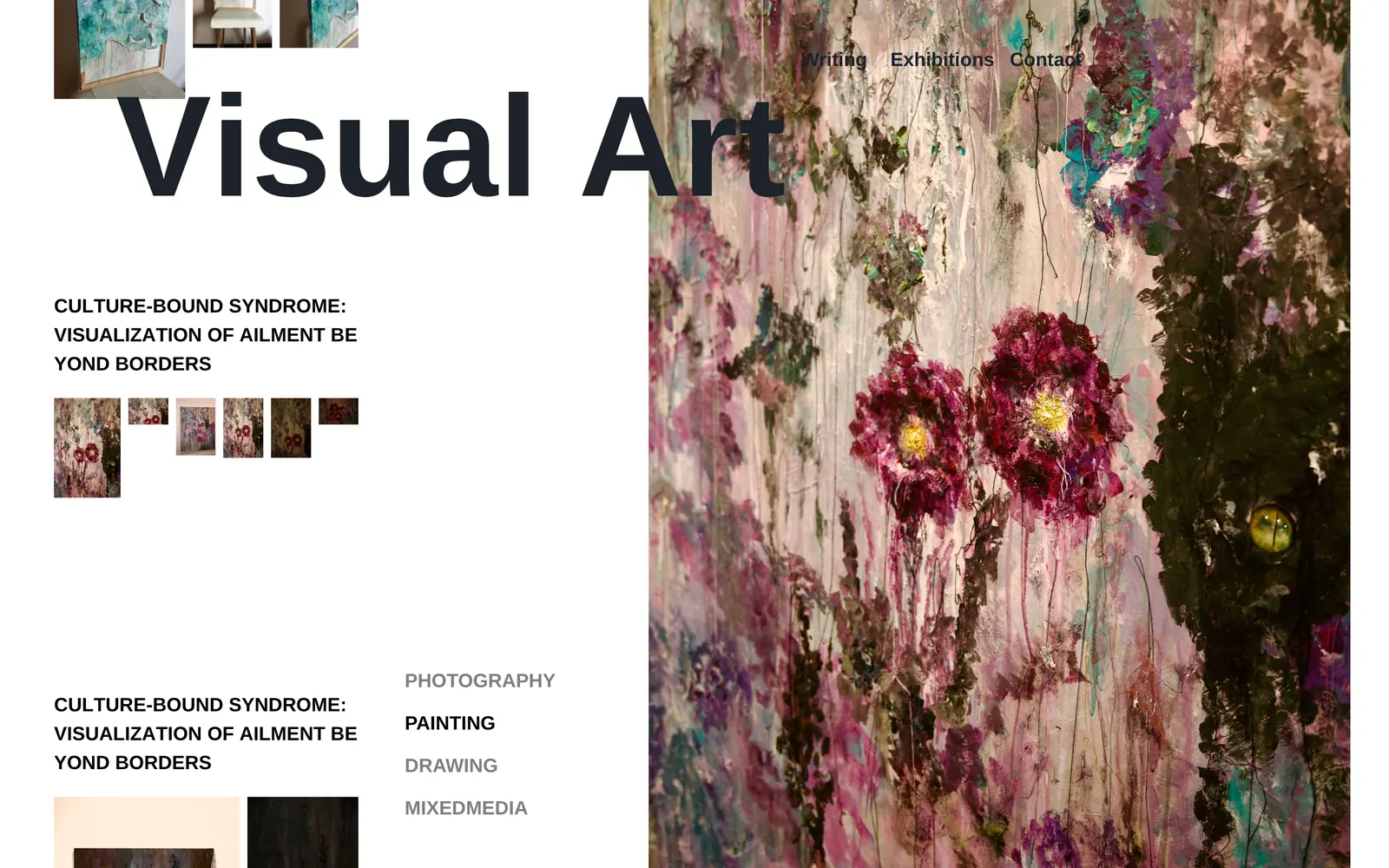
VisitA portfolio site for a visual artist, built end to end — front end, content model, CMS and hosting. The brief was that her work should be browsable in one continuous motion rather than clicked through page by page, which turned the project into an experiment in what current web technology will actually do. It ended up as a custom CSS grid driven by custom properties, with a hand-written scroll-mapping layer over GSAP and Lenis that keeps a column of thumbnails and a column of full-size views in step even though their contents are completely different heights. On a phone the same grid slides sideways instead of reflowing.
The other half of the job was making sure she never has to ask me to change anything. The Sanity studio is shaped around how she actually works — pieces grouped into series, with medium, support material and dimensions, and dates that accept just a year, because that is how artists date work — plus a switch that hides whole sections of the site when she has nothing to put in them. It rebuilds itself when she publishes.
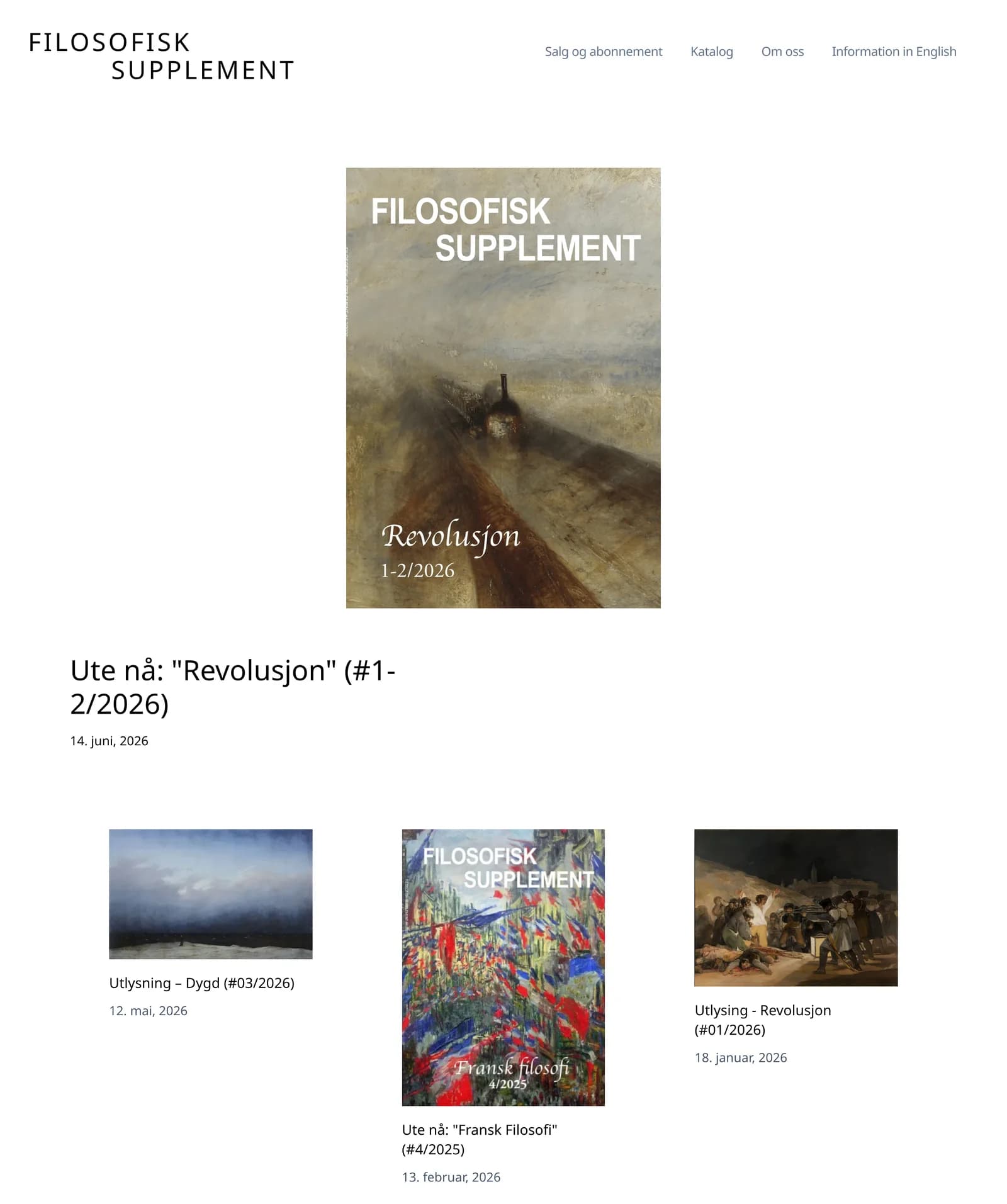
Filosofisk Supplement website
VisitAs part of the editorial board, I created the journal's website from scratch. The key features include easy access to large amounts of textual content for the public, as well as security and user-friendliness for the editorial team, who have limited technical experience.
By avoiding popular CMS solutions and visual editors, I created a solution that ensures security for both the editorial board and the public while enabling long-term storage of textual content. These challenges were addressed by building a server-side rendered website that efficiently handles content serving and storage in a secure, sustainable format.
Get in Touch
Let's work together
I'm always open to short-term projects, as well as longer-term part-time work.
If you liked my work, feel free to reach out to me via email at me@severin.dev